

Percival Hindmarsh, son of Percival of Belsay Barns and brother of William Hindmarsh, the prison warder.
- Birth 1 Dec 1812 in Low Stokoe, Falstone, Northumberland
- Death 25 Feb 1859 in Sydney, NSW, Australia
Christening 1812 24 Dec Falstone, Northumberland Presbyterian
From FindMyPast:
- Perceval HINDMARSH
- Fathers Forenames: Perceval
- Mother: Margaret.
- Birth day: 01/12/1812
- Abode: Low Stokoe Falstone
Percival had an interesting and noteworthy life and, indeed, death.
Percival was born at Stokoe Farm in the depths of the Cheviots after his mother, Margaret Young, had lost maybe 2 daughters at an early age. He then moved with his parents to a remote farm at Belsay Barns in Bolam, where his brother William was born in 1819, just before his mother died, plus also his paternal grandfather at Peels Wellhouse and his paternal aunt Eleanor, who died at 37, within weeks of his grandfather. At this stage, Percival was 8 years old, and his brother William was a toddler. A year later, his father, Percival, died young in 1821, leaving both boys orphans. His father died intestate, i.e. with no will. Events seem to have been complicated at this time as many of the wills were dealt with very slowly, and the intestacy of Percival of Belsay Barns, the boy’s father, wasn’t dealt with until 1843, some 20 or so years later, by which time both orphan boys were grown up and living their own lives.
It would seem that William the grocer and his contacts in Alnwick changed the direction of these 2 farmers’ sons, as both ended up joining the civil service, Percival joining the customs service and William joining the prison service.
Percival in Canada
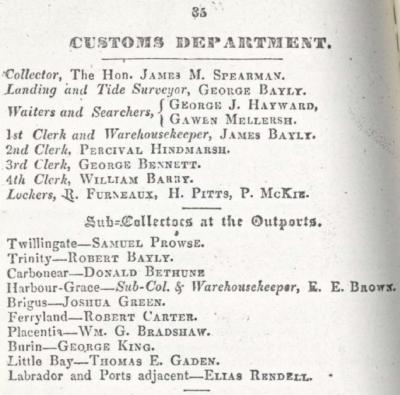
Percival worked as a Customs Clerk at St John’s on Newfoundland Island in Canada, and you can see him listed in the Newfoundland Almanac 1844 here at page 35.
At some point in the early 1800s, probably in Alnwick, Percival had got to know the Baillie or Bayly family of Tadcaster, Yorkshire. In Canada, Percival worked with George, James and Robert Bayly in the Customs department, and in the 1840 Indenture relating to his uncle William’s intestate estate, one of the parties was Richard Baillie of Tadcaster. This Richard Baillie had, on 29 September 1829, in Alnwick, married Jane Cattanach.
In the 1840 Indenture regarding the estate of William (1780) Percival is described as:
“… and Percival Hindmarsh esq late of Alnwick in the County of Northumberland but now of St Johns in the Island of Newfoundland Clerk in Her Majestys Customs ….”
In the grant of administration in respect of Percival’s father’s estate in 1843, Percival is described as:
“… we, Percival Hindmarsh, late of St Johns Newfoundland and now of Alnwick in the County of Northumberland Gentleman …”
This seems to indicate firstly that, in order to sort out his families affairs he was forever travelling from Canada to England, and secondly that his service at Newfoundland started before 1840 and by 1843 he had ceased work with Customs in Newfoundland however he is listed in the Newfoundland Almanac as a Clerk in Customs up to 1849, so he must have returned to Canada after sorting out his father’s affairs.
Percival in Australia
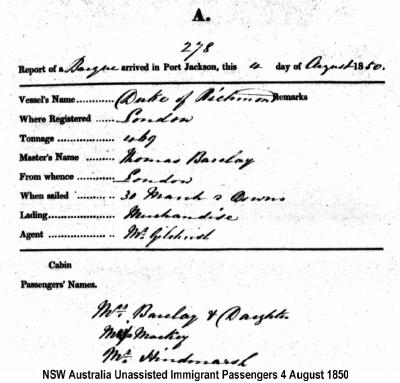
Percival then travelled to Australia in 1850 to take up a similar Customs House position as a tide-waiter.
Arrival 1850 4 Aug Age: 37 Port Jackson, New South Wales on the Duke of Richmond (a small boat of cargo with only a few passengers).
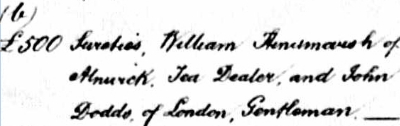
In Australia, in order to work as a customs man, £500 sureties had to be provided. These were given by William Hindmarsh of Alnwick, Tea Dealer, and John Dodds, of London, Gentleman, the bond being deposited at The Custom House, London.
Percival worked in Australia from 1850 until 1859, when he met an early death at the age of 46.
His cause of death is given as natural causes; however, as he was only 46 years old at his death, an inquest had to go ahead, which makes for very interesting reading, as clearly the jury completely ignored the evidence, to the frustration of the coroner. The jury was John Bell (Foreman), Thomas Crossley, Alfred Mayo, John Girvan, James Gosstry, Ebenezar Dewar, Henry Dodds, John Bros and Nicholas Giffard. It is interesting to note that the Hindmarsh family had links to the Bells and the Dodds families in Northumberland.
At one point in the Inquest Report, there is a note after Dr Cox’s evidence:
“NOTE-When Dr Cox was under examination, the foreman constantly interrupted the proceedings, the Coroner remarking, you are determined to allow no evidence to be recorded that discloses facts. The foreman, Mr Bell, remarked, that he was a most intimate friend of the deceased, and that he would have been his Executor if he had but lived to have perfected it.
Coroner: You ought not to have been on this inquest then”
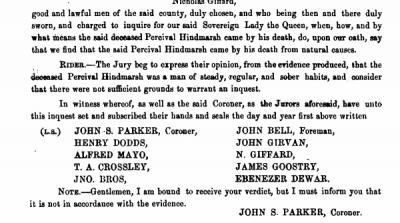
It is quite clear from the Coroner’s comments that he is completely baffled by the jury’s conclusions, and the report says:
“… when, how and by what means the said deceased Percival Hindmarsh came by his death, do, upon our oath, say that we find that the said Percival Hindmarsh came by his death from natural causes.
RIDER – The Jury beg to express their opinion, from the evidence produced, that the deceased Percival Hindmarsh was a man of steady, regular and sober habits, and consider that there were not sufficient grounds to warrant an inquest.
In witness thereof … etc
NOTE – Gentlemen, I am bound to receive your verdict, but I must inform you that it is not in accordance with the evidence.
JOHN S PARKER, Coroner”
Following publication of the Coroner’s Report in the newspaper, John Bell wrote to the paper complaining that the Jury’s Rider had not been included.
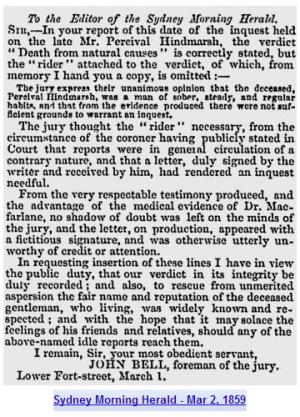
“To the Editor of the Sydney Morning Herald
Sir – In your report of this date of the inquest held on the late Mr Percival Hindmarsh ….. but the “rider” attached to the verdict …. is omitted…
The jury thought the “rider” necessary, from the circumstances of the coroner having publicly stated in Court that reports were in general circulation of a contrary nature, and that a letter, duly signed by the write and received by him, had rendered an inquest needful.
….the letter on production, appeared with a ficticious signature, and was otherwise utterly unworthy of credit or attention.
In requesting insertion of these lines, …. to rescue from unmerited aspersion the fair name and reputation of the deceased gentleman, who living, was widely known and respected ….
JOHN BELL, foreman of the jury.
Lower Fort-Street, March 1″
I find this case quite fascinating. It is quite clear that the Jury agreed that nothing should besmirch Percival’s name, but the question is, why? It is entirely possible that he was part of an “old boys network” in Sydney where there was a level of corruption, but where they all looked out for each other, and maybe he had been a particularly well-respected member of that group and so earned their protection. But clearly this kind of behaviour with regard to Inquests was not usual, and so if the “old boys” argument is to work, you would expect this to happen more frequently.
In addition, there is the matter of the letter referred to in John Bell’s letter to the Sydney Morning Herald. His use of the English of the time makes what he says a little ambiguous, but to my eyes, the gist is that someone had masqueraded as him and had written to the coroner with concerns that led to the inquest. No mention is made of what the letter said, and so I can only surmise as to its contents – one thing I think is for sure, if it had simply said that Percival had drunk himself to death, then there would not have been an inquest in those times, where deaths in your 40s would not have been uncommon. It would be so interesting to see what that letter had alleged, particularly bearing in mind the impending enquiry regarding the functions of the Customs Officers. John Bell, foreman of the Jury, not only was a close friend of Percival, which should, by rights, have barred him from service on the Jury, but he also attempted to disrupt Dr Cox’s evidence with some fortitude, and this only begs the question as to why what was at stake? He either had a great bond of honour to Percival or desperately needed the inquest to conclude that Percival simply died of natural causes, with no further investigation needed.
Interestingly, no post-mortem was done, and it appears that no one suggested that he may have been poisoned; however, this is quite feasible, as clearly he had information relating to the upcoming enquiry. Why did John Bell fight so hard to disrupt the evidence and ensure that the verdict of the Jury was accepted by the general public? What did he have to gain? We will probably never know, but I will keep looking.
Certainly, on the face of it, it does look as if he was very troubled by the impending enquiry and drank too much, which, combined with the extreme heat, led to dehydration and an early death, although it does seem more than likely that other factors may be more than relevant. My justification for this is the extreme measures John Bell and the Jury went to, to disrupt the medical evidence and to bring a false verdict.
One thing that really concerns me is that as I try to transcribe what was written in the paper, it does not correlate with what was written in the report of the inquest, but why?
Transcription of The Report in the Sydney Morning Herald
Votes and Proceedings – Inquest of Percival Hindmarsh p733 You can also go to the Gallery and read the book.
ADDENDUM: Some further information I have found is written up on my Family Research website.
Percival Hindmarsh Death Certificate
- (NSW reg no. 1859/000243)
- Death: 25 February 1859 at Princes Street
- Cause of Death: Inflammation of Lungs, duration 3 days
- Buried: 26 February 1859 at Camperdown Cemetry, witness John Bell
- Birth: Northumberland, Time in Colonies:7 years (this is wrong as it was 9 years)
Percival’s Estate
Percival died without a will, and there is extensive paperwork with regard to his estate. John Dunsmore and Charles Stafford of Sydney were bound by a sum of £2500 as administrators of his estate. Charles Stafford was the legally appointed attorney of William Hindmarsh of Dartmoor Prison Service.
William, Percival’s brother, did not travel to Australia and instead swore various documents, including a Power of Attorney, in Plymouth in front of John Bayly, Notary Public. (The Baylys do seem to have many dealings with the Hindmarsh family; however, as yet, I have not found a family link.) William swears:
“I William Hindmarsh storekeeper at the Dartmoor Prison in the Parish of Lydford in the County of Devon England do solemnly and sincerely declare as follows, namely that I am the Brother of Percival Hindmarsh late of Sydney in the Colony of New South Wales landing waiter who some time since departed this life at Sydney aforesaid Intestate and without ever having been married and that the said Percival Hindmarsh had not either Father or Mother or Brother or Sister or issue of Brother or Sister other than myself and my issue living at the time of his decease…… sixteenth day of December in the year of our Lord one thousand eight hundred and fifty nine.”
In another document appointing John Dunsmore and Charles Stafford as his attorneys, William says:
“.. and whereas I the said William Hindmarsh am now absolutely entitled as the only next of kin of the said Percival Hindmarsh to all the Personal Estate Goods Chattels and Credits which the said Percival Hindmarsh was possessed of or entitled to at the time of his decease…”
Another document, whereby Charles Stafford confirms he is attorney for William Hindmarsh, acknowledges receipt of the document from William on 14 March 1860, and so the letter from Plymouth to Sydney took about 3 months to arrive.
Percival’s possessions had to be sold off, and early in 1859, the following advert appeared in The Sydney Morning Herald:
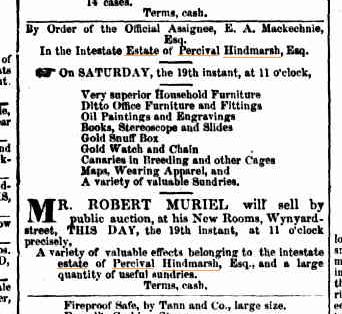
“By Order of the Official Assignee, E. A. Mackechnie, Esq.
In the Intestate Estate of Percival Hindmarsh, Esq.
– On SATURDAY, the 19th instant, at 11 o’clock-
Very superior Household Furniture
Ditto Office Furniture and Fittings
Oil Paintings and Engravings
Books, Stereoscope and Slides
Gold Snuff Box
Gold Watch and Chain
Canaries in Breeding and other Cages Maps, Wearing Apparel, and
A variety of valuable Sundries.
MR. ROBERT MURIEL will sell by
public auction, at his New Rooms, Wynyard street,
THIS DAY, the 19th instant, at 11 o’clock precisely,
A variety of valuable effects belonging to the intestate
estate of Percival Hindmarsh, Esq., and a large quantity of useful sundries.
Terms, cash.”
Later, he advertised a sale for:
“The personal effects of the late Percival Hindmarsh, Esq., and
114 shares in the Australian Gas-Light Company at 12 o’clock precisely”
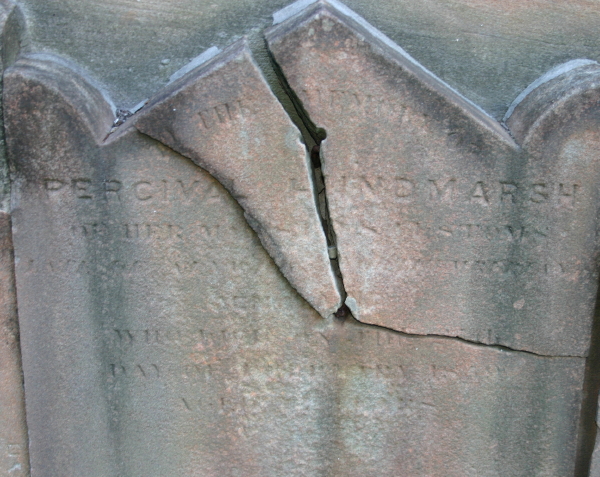
Percival was buried at Camperdown Cemetery, Newtown: Erskineville Anglican http://neac.com.au/
7422 Hindmarsh; Percival. South Wall
The gravestone says, “Percival Hindmarsh of Her Majesty’s Customs and late of Northumberland England died on 25 February 1859”
Percival’s estate raised about £1700 of which, I believe, £1300 was paid out to William Hindmarsh, his brother.